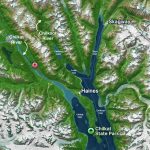
We caught our first glimpse of MV Kennicott at 4:30 pm as she sailed up Chilkoot Inlet. We had to admit seeing her was an exciting moment, marking the end of our Alaska and Northwest Canada adventure and the start to saving MFI three weeks of driving.

In front of the terminal, there were seven lanes in which vehicles lined up for driving aboard. We hitched up Arthur and took our place in line. The load master and several assistants began the vehicle boarding process at about 5 pm. The experienced MFI made it all look easy, and we were perfectly parked by 5:30. We checked in with the purser for our assigned roomette, unloaded our carry-ons in the snug quarters, and were away at 6 pm on the nose. Yet another kudo for AMHS with an on-time departure.


Roomette occupants had a choice of two community restroom/shower facilities. Ours was a convenient 15′ walk from our door. I took the top bunk. The mattresses and pillows were not particularly comfortable, so after that first night, we grabbed ours from Arthur. After settling in, we went to the galley for dinner and then relaxed with a drink in the bar. Our bartender was extremely personable, and she had that unique ability to remember everyone’s name, as well as, a piece of their personal history. Before turning in for the night, I took several sunset pictures. We stopped overnight in Juneau to refuel, and I vaguely remembered docking because the vibration of the engines changed enough to awaken me.


MV Kennicott – Derek Nystrum, Captain
The Kennicott was an Ocean Class Roll on-Roll Off Passenger Vessel built by Halter Marine Inc. of Moss Point, MS. She departed Pascagoula, MS on June 2, 1998; arrived in Bellingham, WA on June 22, 1998; and was delivered to AMHS in Juneau, AK on July 3, 1998. She used an active fin system for roll stabilization, which made for a smooth sail; and had three elevators, one of which was rated for vehicles up to 80,000 pounds. Below was her posted AMHS profile for those readers with seafaring knowledge.

Sitka, AK
As usual, we got up early and enjoyed a leisurely breakfast. The galley had a fantastic coffee machine, where $3 produced an Americano that suited our picky tastes. Our first morning at sea appeared mysterious.


After dining, we wandered around the ship, determined how to navigate between decks, and located the theater and lounge areas. Passengers not staying in any of the accommodations had staked out their spots for sleeping in various areas both inside and on deck. Most looked to be comfortable, but this wouldn’t necessarily have been the case had the ship been full.


The sail from Haines to Sitka (population 8,382 and Alaska’s 5th largest city) was 235 miles, and we had another 5 hours to go. We sailed through the inner passages of the Alexander Archipelago. Much of it was surprisingly narrow from my perspective, so hats off to the Captain. All of it was beautiful.


In Sitka we caught an inexpensive tourist bus downtown and spent 3 hours learning about and seeing as much of the city as possible. Sitka had an extremely rich history and deserved to be visited over days instead of hours. Russian explorers landed there in 1799 and named the settlement New Archangel. Alexander Baranov, the appointed Governor of Russia America, arrived soon afterward under the auspices of establishing a colonial trading company chartered by Tsar Paul I called the Russian-American Company. Baranov managed the company until 1818, but Russia continued governing Sitka until 1867, when the U.S. government purchased Alaska. The city retains a strong Russian character, which we found captivating.
The bus dropped us at the Visitor Center. We walked two blocks to St. Michael’s Orthodox Cathedral, strolled down Lincoln Street, then looped back along the waterfront. Construction of St. Michael’s was funded by the Russian-American Company and finished in 1848. It was the earliest Orthodox cathedral in the New World and the seat of the Russian Orthodox Diocese of North America from 1840 to 1872. The church burned to the ground in 1966; however, parishoners and residents saved most of the cathedral’s valuable contents, rebuilt it using the original blueprints, and resumed services in 1977. The cathedral interior celebrated a group of six saints (5 Russian and 1 American) who served in the Russian Orthodox Church for periods of their lives. They were St Innocent, St Jacob, St Tikhon, St Seraphim, St Anatoli, and St Sebastian.


We window-shopped while moving along traffic-free Lincoln St. On our left was Fisherman’s Alley selling fresh seafood at tourist-level prices. The food looked delicious, but the costs were too rich for our blood!


Several shops later, my eyes caught a window dislay of Russian nesting dolls called Matryoshka. (We own two 7-doll versions, although only one is from Russia.) I’m glad I took this picture, because once we entered the store, there were signs everywhere warning DO NOT TOUCH and NO PICTURES. I wanted to take photos so-o-o-o badly. A portion of the store was stocked with all manner of Russian and Alaskan chotchkies, but the majority of the space was dedicated to extremely high-end art pieces and artifacts that blew our minds. For example, there were life-sized sculptures of bald eagles, and you could actually buy the tooth or tusk of a Wooly Mammoth, if you were filthy rich. The prices were so extravagant, that the king crab legs suddenly seemed like a bargain.
At the end of Lincoln St was a 15′-tall statue titled “The Prospector” by sculptor Alonzo Victor Lewis. It stood on the landscaped grounds in front of the Alaska Pioneers Home. The Home was originally built by Russians in 1879 as a U.S. Marine barracks. The military base expanded and buildings were added until it closed in 1912. Fortunately, the residents of Sitka wanted a home for the increasing number of pioneers, prospectors, and others who were no longer able to care for themselves. Sitka’s Territorial representative introduced a bill to appropriate $10,000 to establish the Home, the Department of the Navy allowed the old barracks to be used for care purposes, and the Home opened in September 1912. By the 1930s, the Home was dilapidated and a fire hazard , so Congress granted the Naval Reserve property to the Territory of Alaska. At that time, the current concrete building was constructed and accommodated 170 men. In 1956, the legislature funded a women’s home, and the North Wing was added. Today the Home serves 65 men and women and, according to their website, was committed to “…providing compassionate care to elders, staff, family, and community by nurturing the body, mind, and spirit and preserving dignity and individuality.”


We walked back to the Visitor Center along Sitka’s scenic waterfront. We observed some residences, passed by the harbor, and took in the beautiful vistas. The Kennicott departed Sitka at 4 pm sharp.


Ketchikan, AK
Once we were underway, Captain Nystrum announced we would not be stopping in Petersburg or Wrangell, AK as originally planned. The ships forward thrusters were not functioning properly, so we headed directly to Ketchikan (population 8,079) where repairs had been scheduled. With this change, we sailed the 187 miles to get there across a more open-ocean route and experienced a lot of rocking and rolling overnight. We docked in Ketchikan mid-morning Wednesday and were told we had about 5 hours before needing to reboard. We caught a city bus and rode to the south end of town, because MFI had a plan.
MFI wanted to find Leah Pflaum, an acquaintance made when we were volunteering at Pisgah View Ranch in NC. She believed Leah’s husband was a fisherman, so we walked through the Thomas Basin Boat Harbor hoping to see an office where we might ask. Nothing! As we were leaving the docks, MFI stopped a man getting into his truck and asked if he was a fisherman. He replied yes and politely offered to help. Unfortunately, he didn’t know any fisherman by that name but pointed us to the Potlatch Bar where he assured us that if our friend was a local fisherman, the owner would know. The owner didn’t know the name but brought us the local phonebook, in which MFI found a listing for Leah’s mother-in-law. After explaining who we were and how we knew Leah, she gave Leah’s phone number to MFI, who then called and had a great conversation. BTW, Leah confirmed that her husband was NOT a fisherman.


Hungry from our search, we walked a block north on Stedman St. and enjoyed a superb cup of coffee, lunch, and a decadent dark chocolate dessert at the New York Cafe. We love finding dining gems such as this. Completely sated, we continued a half block further north and toured the Creek Street National Historic District. At the turn of the 20th century, a group of twenty independent and enterprising women worked and lived in their homes along Ketchikan Creek. They thrived until the 1950’s, before prohibition and the banning of prostitution forced the area onto hard times and the homes fell into disrepair. Fortunately, the Historic District facilitated renewed interest, investment, and reconstruction of this iconic Ketchikan landmark, and thanks to tourism, it has flourished since the 1970’s. The restored homes housed retail shops, restaurants, and museums. One Museum & Gift Shop was called Dolly’s House, and the sign on the side of the building evoked history and humor.


After strolling the length of the boardwalk, MFI broke off and went to the Tongass Historical Museum and Totem Heritage Center. I took a much closer look along the creek before joining her. The salmon were indeed running and could be seen in the hundreds. Unfortunate for them, the Harp Seals were understandably taking advantage of the free meals. About 100 yards from the north end of the boardwalk was a salmon ladder built by the city. Just downstream from it, I watched in disbelief as a teen in a swimsuit was catching salmon with his bare hands. There was no way he could eat what he had captured, so I presumed he was selling them.


Joining MFI at the Tongass, she gave me a great recap tour of the highlights. We saw a unique collection of artifacts and displays, which provided a deep and interesting insight into Ketchikan’s past, present , and future. We hiked back to the Kennicott for a dinner-time departure. I loved this detailed wall mural from the Tongass Museum.

Bellingham, WA
We had two more nights on board and 685 miles remaining to reach Washington. After three days at sea, we were beginning to feel like old salts. Here’s a picture of the dinner menu board to provide readers an appreciation of what we were eating for dinner. The galley offered many pre-packaged items, a chilled cabinet with single-portion desserts and salads, a self-serve line of vegetables plus other salad varieties, and the chef’s window for ordering the evening’s hot meal choices. For breakfast, we usually shared a vegetable omelet or hot bowl of oatmeal garnished with the works. And for lunch, either an egg or chicken-salad sandwich. We also brought our Yeti filled with cheese and crackers, protein bars, beef jerky, and trail mix. We did NOT go hungry.

During our last day, we sailed through Queen Charlotte Strait, Johnstone Strait, Race Passage, and Discovery Passage, all of which formed the north end of the narrow eastern route off Vancouver Island. The weather was pleasant, so passengers returned to the bow with the hopes of seeing sea or land wildlife. I got caught up in this just long enough to realize the futility. I witnessed a group of young travellers who played on the emotions of passenger hopes by faking a sighting and getting everyone to move to the gunwales and stare in vain. About the time everyone felt like giving up, the Captain announced a pod of Orcas off our starboard. Difficult to pholograph!


The Kennicott sailed into Bellingham Bay at 7 am on Friday, 20 September 2024. We were experiencing mixed emotions. We’d been on the road since 22 May and had been enjoying non-stop activities and excitement for nearly four months. But to say we weren’t tired and ready for a return to normal travel would have been a gross understatement.